


Saltwater Filtration System
Currently, climate change is causing droughts and rising sea levels to become increasingly severe. This leads to coastal areas facing the problem of saltwater intrusion. Therefore, an effective solution is needed to address this situation. And Saltwater filtration system are one of the solutions that are receiving much attention.
1. Why is a Saltwater Filtration System necessary?
Water plays an indispensable role in human life. Therefore, when water becomes saline, it causes certain negative impacts. Using a Saltwater Filtration System will effectively solve this problem.
1.1. Understanding What Saltwater Is
Saltwater is water containing an excessive amount of dissolved salt (NaCl). Saltwater intrusion often occurs due to seawater inland, causing salt contamination of rivers, ponds, and lakes.
To help you better understand saltwater, MIEN NAM FILTRATION EQUIPMENT TECHNOLOGY provides the following indicators for identifying saline water:
- Freshwater has a PPT index below 1 and a dissolved salt concentration (NaCl) below 250 mg/l.
- Saltwater has a PPT index between 10 and 30 and a dissolved salt concentration (NaCl) above 300 mg/l.
As shown in the table above, the water we use for daily life should have a PPT level below 1 PPT/L and a dissolved salt content not exceeding 300 mg/L. Water is considered saline when the parameters exceed the limits set above.
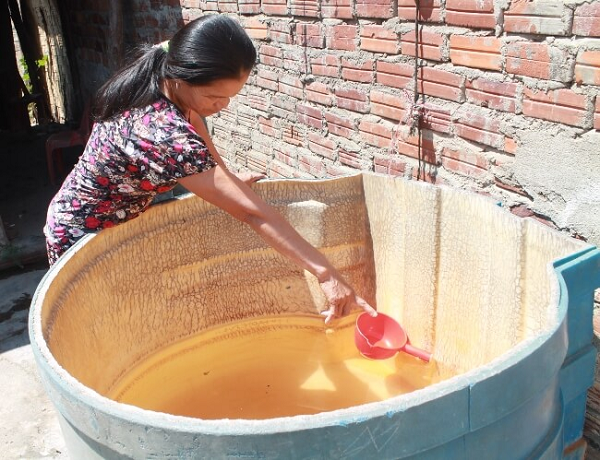
Saline water is water where the concentration of NaCl exceeds the permissible limit.
1.2. Harms of Using Salty Water
Using salty water can have many negative consequences for our lives, specifically as follows:
- Health EffectEffects: Using untreated salty water seriously affects health. When saltwater enters the body, the water content in the salt draws water from cells, causing dehydration and cell shrinkage and death. This weakens the immune system, making it easier for bacteria to invade and cause digestive diseases and kidney failure.
- Impact on Production: Water is essential for production, especially agriculture. Saline water will cause soil degradation, preventing plant growth and death, leading to crop failure and negatively impacting the economy.
- Impact on Daily Life: Using saline water for bathing and washing clothes can cause skin diseases such as dermatitis, scabies, and ringworm. Furthermore, saline water can damage household appliances and electrical equipment.
Because of these harmful effects, a saline water saltwater filtration system is necessary to ensure a healthy life for everyone.

Saline water prevents plants from growing and causes them to die.
2. Structure and Operating Principle of a Saltwater Filtration System
Saltwater filtration systems are essential for the lives of people in coastal areas where water sources are contaminated with salt. So, what is the structure and operating principle of this type of product?
2.1. Structure of the Saltwater Filtration System:
The brackish and saltwater filtration system is made up of several different components, including:
- Inlet water supply unit.
- Chlorine dosing system for water disinfection.
- Raw water storage tank.
- Water pump.
- Multi-stage filter system to reduce turbidity and heavy metals.
- Activated carbon filter system to remove odors, organic chemicals, and chlorine.
- The RO water filtration system is designed to treat saltwater.
- Water sterilizer.
- Storage tank for the treated water.
- Calcium filter to neutralize the pH of the treated water.
- Finished water.
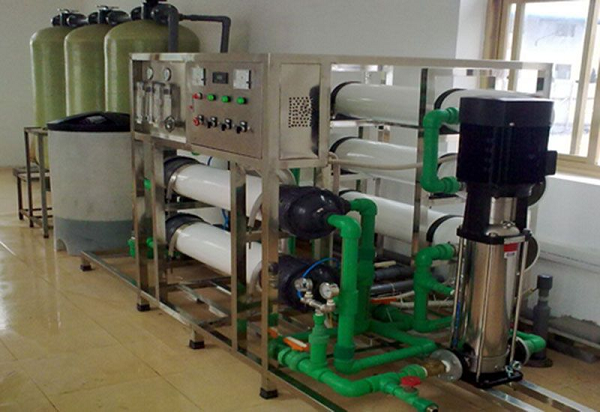
Saltwater Filtration System is made up of many components.
2.2. Operating Principle
Saltwater filtration system operates in two main stages:
- Pre-treatment stagstage: The water supply for the desalination system is fed into the pre-treatment system. This system must be custom-designed to optimize the operation of the RO desalination membrane. The lower the water quality, the more complex and costly the pre-treatment system will be.
- Desalination stagstage: After pre-treatment, the saltwater is passed through the RO membrane under the action of a booster pump. The RO membrane, with its small pores, filters out pollutants and salts from the water, purifying it. The salts and pollutants are then removed through the wastewater outlet.
3. Practical Applications of Saltwater-to-Freshwater Filtration Systems
Saltwater filtration systems are widely used in many fields, including:
- Providing clean water for cargo ships and yachts.
- Supplying water to households in saline-affected coastal areas.
- Coastal resorts, hotels, and restaurants.
- Seafood processing plants and factories.
- Coastal villas.
Saltwater Filtration System are used to provide clean water in many fields.
4. Several Methods for Purifying Saltwater into Freshwater
When water is contaminated with salt, effective treatment depends on the specific situation. Here are some methods for purging saltwater into freshwater that you can consider:
4.1. Distillation Method
This method is relatively commonly used by water treatment plants. The process involves heating seawater to 100°C (2256 kJ/kg). Thus, with 539 kcal, 1 kg of freshwater can be obtained. Water molecules evaporate, while organic and inorganic substances do not. The water vapor then condenses into pure water.
This method has relatively low power consumption, primarily using heat for separation. However, using this method will require a certain amount of maintenance costs due to the risk of scale buildup and blockage in the heat exchanger.
4.2. RO Membrane Filtration Method (Saltwater Filter)
To filter saltwater into freshwater using an RO membrane, the following four stages are required:
- Stage 1: A PP membrane pre-filter removes suspended solids larger than 5 micrometers.
- Stage 2: After removing large solids, the water is drawn through a second filter made of activated carbon. Here, residual chlorine molecules are retained.
- Stage 3: Water passes through a PP1 membrane (a filter made from compressed cotton fibers with a size of 1 micrometer), where larger molecules are retained.
- Stage 4: Water is pushed through an RO membrane (very small pore size) to remove remaining impurities and bacteria. Next, the water passes through a T-33 (silver nano-membrane) to adjust pH and disinfect. This results in pure, uncontaminated water.
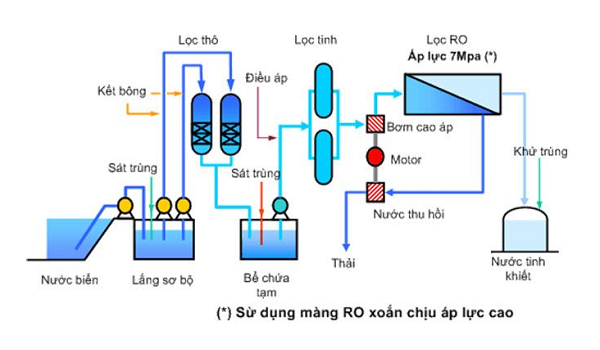
Use RO membranes to filter saltwater.
4.3. Ion Exchange Method
With this method, ion exchange resin plates are first manufactured. Positive ion exchange resins are called cation resins, and negative ion exchange resins are called anion resins. When seawater passes through the tank containing the resin plates, Na+ ions are retained, pushing H+ ions into the water. Cl- ions are absorbed by anions, pushing OH- ions into the water. The water exiting the filter tank will have low levels of Na+ and Cl- ions, thus producing fresh water.
Saltwater Filtration System play a crucial role in the daily lives of people in coastal areas where water is contaminated with salt. Based on the actual water source situation, the most effective treatment method can be determined.
__________________________
𝑪𝒐̂𝒏𝒈 𝑵𝒈𝒉𝒆̣̂ 𝑻𝒉𝒊𝒆̂́𝒕 𝑩𝒊̣ 𝑳𝒐̣𝒄 𝑴𝒊𝒆̂̀𝒏 𝑵𝒂𝒎 - 𝑮𝒊𝒂̉𝒊 𝑷𝒉𝒂́𝒑 𝑪𝒉𝒐 𝑯𝒆̣̂ 𝑻𝒉𝒐̂́𝒏𝒈 𝑳𝒐̣𝒄
🌐 https://thietbilocmiennam.vn/
📞 0938.141.584 hoặc 0902710518
📩 miennamfilter@locmiennam.com
🔴Youtube: Công Nghệ Thiết Bị Lọc Miền Nam
📘 Facebook: CTy TNHH Công Nghệ Thiết Bị Lọc Miền Nam
📱 Zalo OA: Công nghệ thiết bị lọc Miền Nam